
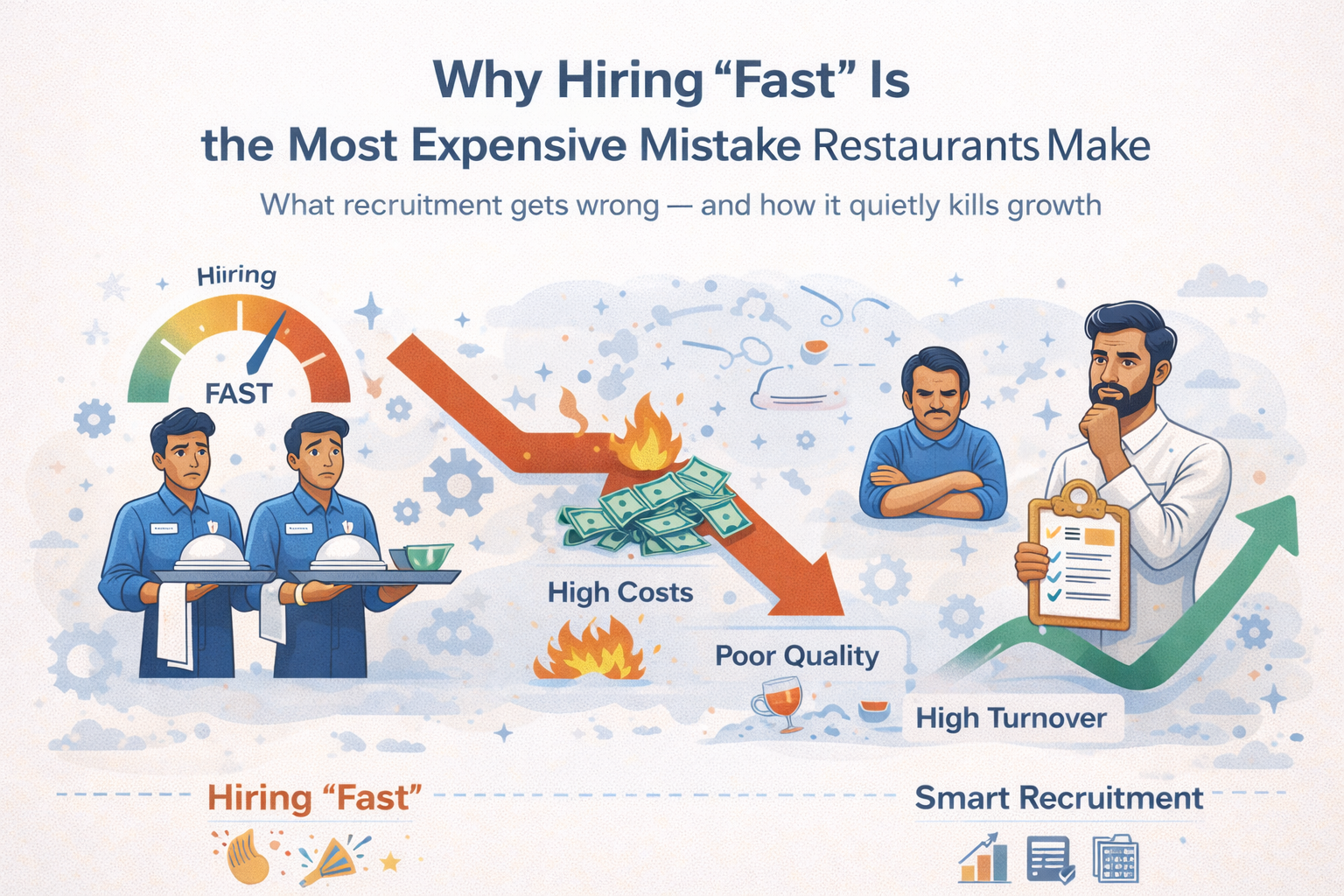
What recruitment gets wrong — and how it quietly kills growth
Most restaurant hiring decisions are made under pressure.
Someone quits. Service suffers. Gaps open up. The instinct is simple. Hire fast and move on.
On the surface, this feels efficient. In reality, it is one of the most expensive mistakes a growing restaurant can make.
The cost rarely shows up immediately. It appears months later, disguised as chaos, inconsistency, and stalled growth.
The illusion of speed
Fast hiring feels productive. A position gets filled. The problem seems solved.
But speed often replaces clarity.
When roles are poorly defined, expectations are vague, and screening is shallow, the hire looks fine on paper but struggles in practice. Training takes longer. Supervision increases. Decision making slows down.
What felt like momentum quietly becomes drag.
Why bad hires don’t fail loudly
Most wrong hires do not crash and burn.
They underperform just enough to be tolerated. They need extra follow ups. They make small errors that compound. They struggle to scale with the business.
In hospitality, this is dangerous.
Because service still runs. Orders still go out. Revenue does not collapse overnight.
Instead, growth flattens.
The hidden cost founders underestimate
A wrong hire costs far more than salary.
It costs management bandwidth. It creates inconsistency in execution. It breaks team morale. It forces founders back into day to day firefighting.
In aggregator led businesses, this cost is amplified. Kitchen errors affect ratings. Delay affects visibility. Inconsistency affects algorithm trust.
What looks like an HR issue becomes a growth issue very quickly.
Resume led hiring is not enough
Most recruitment in restaurants is resume first.
Titles, brand names, years of experience.
Very little time is spent evaluating decision making, adaptability, or pressure handling. Even less time is spent assessing whether the candidate can grow with the business.
This is why teams that look strong on paper struggle in reality.
Hospitality does not reward static skill sets. It rewards people who can learn, adapt, and execute consistently under stress.
Growth breaks teams before it breaks systems
As restaurants scale, complexity increases.
More orders. More platforms. More moving parts.
People who performed well at lower volumes often struggle when demand spikes. Systems expose weaknesses. Communication gaps widen.
This is where thoughtful hiring matters most.
Teams built for today rarely survive tomorrow’s scale.
What strong hiring actually looks like
Good hiring is slower at the start and faster over time.
Roles are clearly defined. Expectations are specific. Screening focuses on thinking, not just experience. Early interviews filter out misfits before they enter the system.
The result is not perfection. It is alignment.
Aligned teams require less supervision. They absorb growth better. They make fewer costly mistakes.
The part nobody tells you
Hiring fast feels like progress. Hiring right creates it.
Restaurants that scale cleanly do not have better luck with people. They have better discipline with recruitment.
They treat hiring as infrastructure, not a reaction.
Growth doesn’t come from doing more things.
It comes from doing the right things — in the right order — consistently.
