
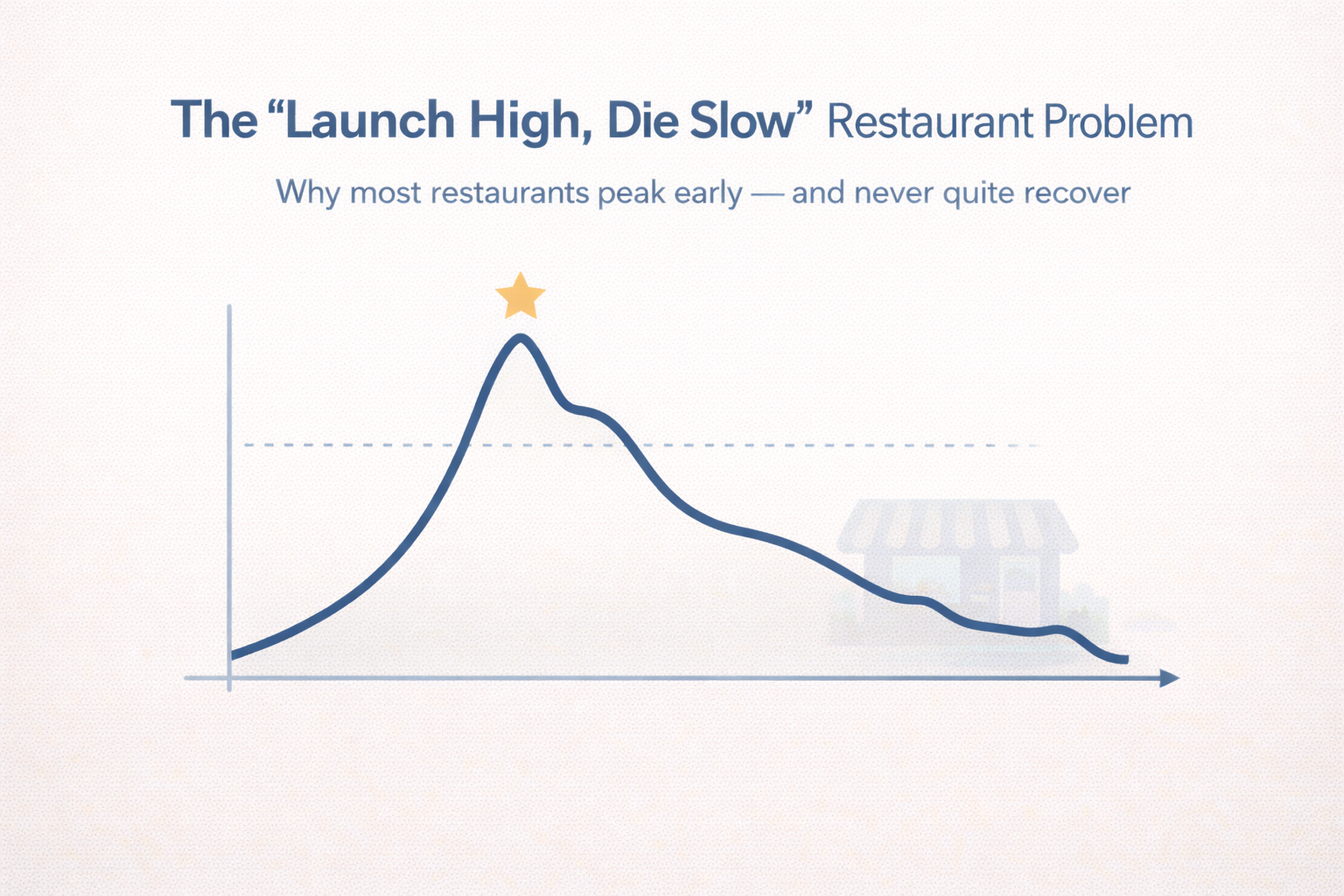
Why most restaurants peak early — and never quite recover
The first few weeks feel unreal.
The restaurant is full. Orders flow in. Reviews are strong. Friends, early supporters, and curious diners show up in large numbers.
There is momentum. There is validation. It feels like the hardest part is over.
For many restaurants, this is the peak.
Not because the concept was weak. But because what comes after the launch is rarely designed with the same care.
Launch creates excitement. Growth needs structure.
Launch energy is emotional. It is driven by novelty, curiosity, and goodwill.
Growth is operational. It depends on systems, consistency, and behaviour.
Most restaurants prepare obsessively for the opening and underestimate everything that follows.
When the buzz fades, the cracks begin to show.
What really happens after the first 90 days
Once the initial rush settles, reality sets in.
Footfalls even out. Delivery volumes stabilise. Teams begin to feel the pressure of daily operations. Founders step back, assuming the business has found its rhythm.
But underneath, many systems are still running on launch mode.
This is where slow decline starts. Not dramatic enough to alarm anyone. Not strong enough to build on.
The post-launch blind spot
Most brands invest heavily in pre-launch menus, interiors, marketing, and PR.
Very few invest in post-launch structure.
Questions like how the menu should evolve, how repeat behaviour is encouraged, or how operations will scale with consistency are often left unanswered.
Without these answers, early success becomes fragile.
Why growth quietly stalls
The issue is rarely demand.
More often, the menu was designed for first impressions, not long-term ordering. Operations were optimised for peak days, not everyday consistency. Teams were hired to survive opening pressure, not to grow with the business.
None of these fail immediately. They simply limit what the restaurant can handle next.
Sustainable growth requires a second playbook
The first playbook gets you open.
The second one determines whether you last.
Restaurants that move beyond early plateaus treat months two to six as seriously as launch week. They refine menus using real behaviour, not instinct. They stabilise teams before expanding. They replace adrenaline with routines.
This is where strong brands separate from short-lived ones.
The part nobody tells you
A strong launch does not guarantee a strong business.
It only buys you time.
What you build once the excitement fades decides whether growth continues or slowly disappears.
