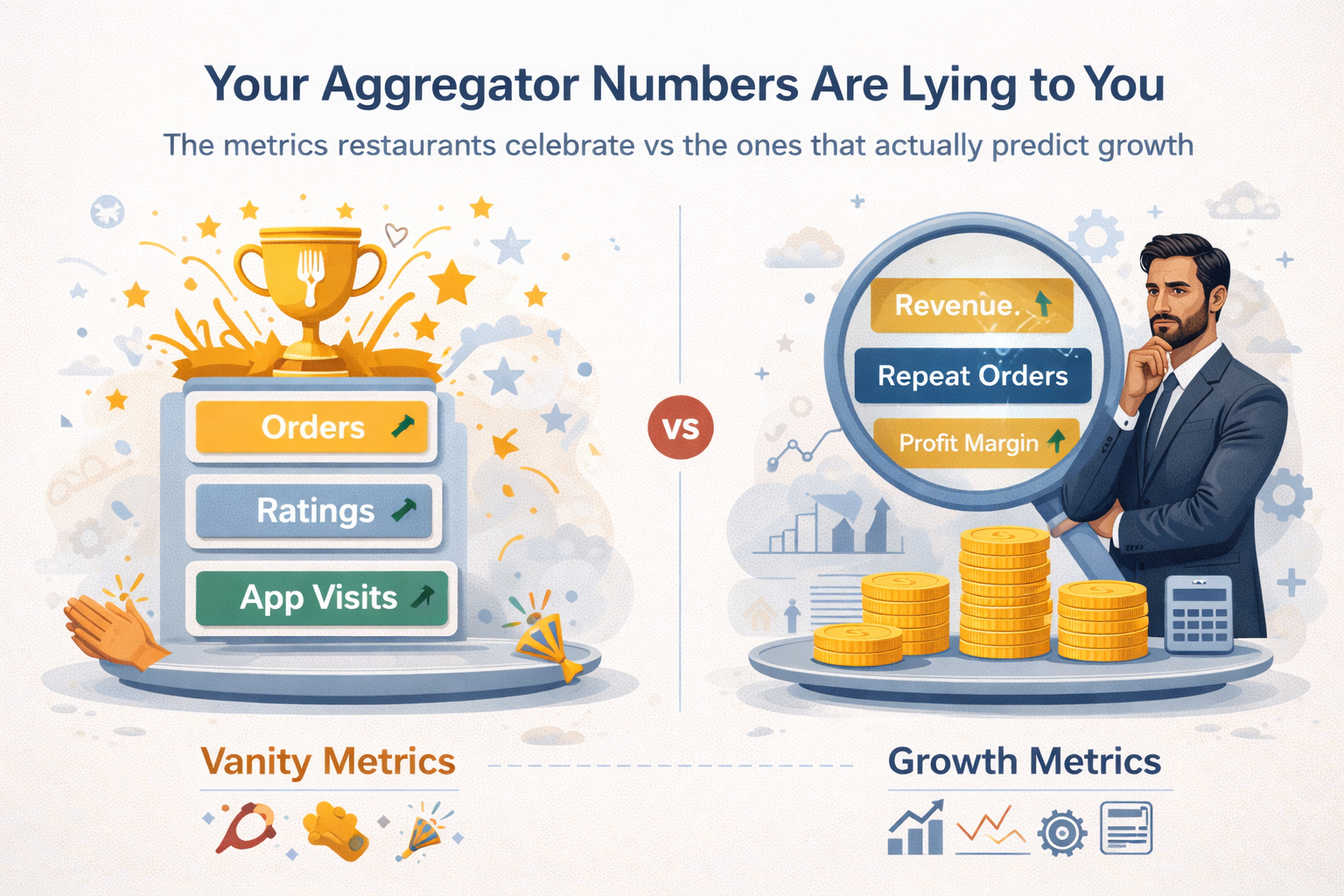
The metrics restaurants celebrate vs the ones that actually predict growth
Most restaurant founders know their numbers.
They know last month’s GMV. They know how many orders came in. They know whether sales went up or down.
And yet, many of these same brands feel confused about their growth. Revenue rises, but confidence doesn’t. Ads run, but control feels weak. Performance looks fine on paper, but the business feels fragile.
That’s because the numbers most restaurants track are not the numbers that explain what’s really happening.
The problem with headline metrics
GMV, order count, and average order value are outcomes. They tell you what happened after the platform has already made its decisions.
They do not tell you why growth happened, whether it is sustainable, or what will happen next.
Celebrating these numbers without understanding what drives them is like checking your bank balance without knowing your expenses.
Comforting, but misleading.
The metrics that create false confidence
There are a few numbers that restaurants tend to overvalue.
High ad driven GMV often looks like growth, even when organic discovery is weakening underneath.
Rising order counts can hide declining repeat behaviour.
A stable AOV can feel reassuring, even when menu depth is collapsing.
Individually, none of these are alarming. Together, they create the illusion of control.
What actually predicts aggregator growth
The metrics that matter most rarely sit on the top line.
Organic menu opens tell you whether the platform still trusts your brand to be discovered without paid pushes.
Repeat order behaviour shows whether your menu structure is strong enough to bring customers back naturally.
Item level distribution reveals whether growth is spread or fragile.
Order timing and preparation consistency quietly influence how aggressively the algorithm promotes you.
These numbers do not look impressive in isolation. But they predict growth far better than revenue ever will.
Why dashboards don’t save you
Most restaurants have access to more data than they know what to do with.
The problem is not access. It is interpretation.
Looking at numbers without context often leads to the wrong decisions. Brands increase ad spends when organic signals are dropping. They add new items when distribution is already weak. They chase AOV when repeat behaviour needs fixing first.
Data without hierarchy creates noise. Noise leads to reactive decisions.
The difference between visibility and trust
Aggregator platforms do two things. They give you visibility, and they decide how much to trust you with demand.
Visibility can be bought. Trust has to be earned.
Metrics that measure trust are slower, quieter, and less exciting. But they compound.
Restaurants that focus on these signals find growth becoming more predictable. Less spiky. Less dependent on last minute interventions.
How strong brands read their numbers
Strong brands do not look at dashboards daily and react emotionally.
They track a small set of signals weekly. They look for patterns, not spikes. They fix one constraint at a time.
Most importantly, they know which metric to act on first and which ones to ignore temporarily.
This clarity is what separates growth that feels stressful from growth that feels controlled.
The part nobody tells you
Not all numbers are meant to make you feel good.
Some numbers exist to keep you honest.
If you only track what looks impressive, your business will eventually surprise you. And rarely in a good way.
Growth becomes easier to manage when you stop chasing outcomes and start managing inputs.
Growth doesn’t come from doing more things.
It comes from doing the right things — in the right order — consistently.